


YAMAHA Scooter
Wednesday, 20 June 2012Yamaha Ray


Yamaha Ray
Maxabout Review
Yamaha rocks at Auto Expo 2012
Friday, January 06, 2012
Yamaha India has rocked the Auto Expo 2012 with the launch two special edition bikes, unveiled all-new global scooter and displayed 2012 model of Yamaha YZF-R1. Yamaha Xeon 125, Mio and Fino scooters were also on display. The
company is planning to increase its production capacity in the country
from the current 6.5 lakh units to 10 lakh units by 2013. Yamaha, which
already has two plants in India, is also planning to come up with a
third plant. Yamaha kept its promise by unveiling all-new global scooter 'Ray'
at the auto show, it was unleashed by none other than John Abraham. The
shade on display was striking purple in combination with jet black. The
gearless scooter is aimed squarely at girls and the production version
of the Ray Concept will be developed in coming months and it will be
on-sale by the end of this year or early next year. Yamah also launched
two special edition bikes, one is Yamaha R15 Limited Edition Fiery Red and second is Yamaha R15 50th Anniversary Red & White.
Yamaha R15 Limited Edition Fiery Red has been painted in a striking red
shade with flame decals on both sides. Yamaha R15 50th Anniversary Red
& White is inspired from the anniversary editions of Yamaha YZF-R1,
R6 and R125 and looks awesome in red and white. The As per the company
both the bikes are very exclusive and only 4000 units will be
manufactured. Yamaha R15 50th Anniversay is priced at Rs. 1.11 lakh
(ex-showroom New Delhi) and the Fiery Red Limited Edition R15 is priced
at Rs. 1.10 lakhs (ex-showroom New Delhi), which is around Rs. 3000-3500
costly than the regular Yamaha R15 Version 2.0. Other bikes on display were Yamaha R15 Version 2.0, FZ16, FZS, Fazer, YZF R1, FZ1 and othe
r regular models from Yamaha India's Stable.
 Popularity
Expected PriceN/AExpected End 2012 (Unveiled at Auto Expo 2012) Social |
VEHICLE SUMMARY | |
| Name: | Ray Concept |
| Type: | Scooter |
ENGINE SPECIFICATIONS | |
| Displacement: | 0cc |
| Engine: | NA |
| Maximum Power: | NA |
| Maximum Torque: | NA |
| Gears: | Automatic |
| Clutch: | NA |
| Bore: | 0 |
| Stroke: | 0 |
| Cylinder Configuration: | NA |
| Chassis Type: | NA |
| Cooling Type: | Air Cooling |
| Carburetor: | NA |
DIMENSIONS | |
| Length: | N/A |
| Width: | N/A |
| Height: | N/A |
OTHER SPECIFICATIONS | |
| Electrical System: | NA |
| Headlamp: | Halogen |
| Battery Type: | NA |
| Battery Voltage: | NA |
| Battery Capacity: | NA |
| Battery Charger Type: | NA |
| Horn: | Dual |
| Wheel Type: | Alloys |
| Wheel Size: | 0 mm |
| Tubeless: | |
| Colors: | NA |
NEW DIO
HONDA DIO
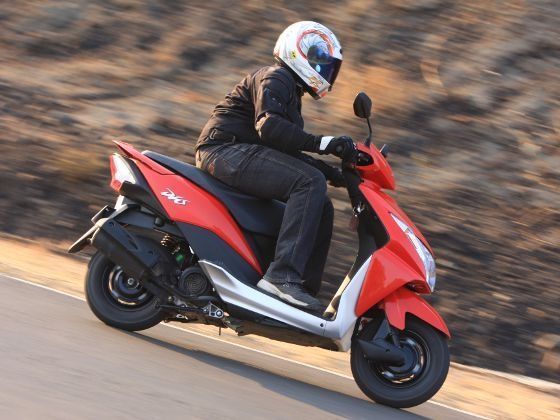
The college-goer's heart throb, the Honda Dio has seen a complete revamp this year. We get our hands on the scooter every teenager wants and find out just what Honda has been up to
 While most guys in the country lust for motorcycles, fast and
aggressive, more often than not, at least in the urban setting, chances
have it that the first two-wheeler that everyone gets their hands on as
soon as they turn 18 is an automatic scooter. Scooters are usually the
underdogs in the two-wheeler market though they are in great demand from
every sort of buyer, from college kids to men and women of all ages.
And there is no denying that the scooter that really rules the roost in
India is the Honda Activa.
But as good a scooter as the Activa is, it does lack panache. So for
those who want a bit of flamboyance while keeping the Activa’s
practicality, Honda has been offering another gem for quite a few years
now – the Dio.
While most guys in the country lust for motorcycles, fast and
aggressive, more often than not, at least in the urban setting, chances
have it that the first two-wheeler that everyone gets their hands on as
soon as they turn 18 is an automatic scooter. Scooters are usually the
underdogs in the two-wheeler market though they are in great demand from
every sort of buyer, from college kids to men and women of all ages.
And there is no denying that the scooter that really rules the roost in
India is the Honda Activa.
But as good a scooter as the Activa is, it does lack panache. So for
those who want a bit of flamboyance while keeping the Activa’s
practicality, Honda has been offering another gem for quite a few years
now – the Dio.
 So finally at the Delhi Auto Expo 2012, Honda unveiled the next
generation of its scooter which will cater to the younger masses. And
the first thing that really strikes you is the completely redesigned
front end of the bike. The trapezoidal headlight and the two sliver like
indicators have been replaced by a massive new unit that incorporates
the headlight and indicators into one near seamless piece that is
sprawled all over the front body panel. The new Dio of course retains
the headlight-less unbroken handlebar shroud from the older bike and
though its design is pretty similar, it does sport a few additional
lines and curves. The front fender is new as well as the centre panels
which connect the front of the bike to the rear have also seen a massive
revamp and even feature a jutting out portion on either side of the
bike which doubles as the passenger footrest. The side, the tail, the
massive tail light cluster with integrated clear lens indicators, the
grab rail – everything is new. In fact, apart from the tyres and a few
bits and bobs like the switchgear and levers, you won’t find a single
external bit that has been carried over from the earli
So finally at the Delhi Auto Expo 2012, Honda unveiled the next
generation of its scooter which will cater to the younger masses. And
the first thing that really strikes you is the completely redesigned
front end of the bike. The trapezoidal headlight and the two sliver like
indicators have been replaced by a massive new unit that incorporates
the headlight and indicators into one near seamless piece that is
sprawled all over the front body panel. The new Dio of course retains
the headlight-less unbroken handlebar shroud from the older bike and
though its design is pretty similar, it does sport a few additional
lines and curves. The front fender is new as well as the centre panels
which connect the front of the bike to the rear have also seen a massive
revamp and even feature a jutting out portion on either side of the
bike which doubles as the passenger footrest. The side, the tail, the
massive tail light cluster with integrated clear lens indicators, the
grab rail – everything is new. In fact, apart from the tyres and a few
bits and bobs like the switchgear and levers, you won’t find a single
external bit that has been carried over from the earli er bike.


Subscribe to:
Posts (Atom)

